Acupuncture Charts
Hand Acupuncture Charts, Meridian Atlas, Five Element Theory...

Acupuncture Formulas

Acupuncture Meridians

Acupuncture Products Directory

Free Acupuncture Quizes
Test yourself on point locations, indications, five element theory and command points.

AcupunctureProducts.com Quizes

Five Element Acupuncture ChartFree Acupuncture Quizes
Test yourself on point locations, indications, five element theory and command points.

The five element theory is the cornerstone of acupuncture and meridian therapy. This chart clearly shows the relationship of the five elements (Fire, Earth, Metal, Water and Wood)

Acupuncture Point Location Quizes
Chest, Abdomen and Back - 21 Quizes

Welcome to Acupuncture Products free quiz section. Match the five points with their correct location. Click on the answer button to view the answers. Download our free point location booklet to study before tacking the test. There are two numbering systems with the bladder meridian, both point numbers are listed. Choose a body area to start with.
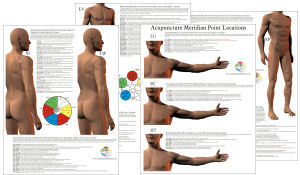
Download the point locations HERE

Body Location: | Head and Neck | Face | Chest, Abdomen and Back | Arm | Hand | Leg | Foot |

Chest, Abdomen and Back: Quiz | 1 | 2 | 3 | 4 | 5 | 6 | 7 | 8 | 9 | 10 | 11 | 12 | 13 | 14 | 15 | -16 | 17 | 18 | 19 | 20 | 21 |

Acupuncture Point

A GV-14 Dazhui

D ST-13 Qihu

E KI-24 Lingxu

B ST-28 Shuidao

C SP-14 Fujie

Point Location

A: Below the spinous process of C7

B: 2 cun lateral to the midline lateral to CV4, 3 cun below the umbilicus.

C: 1.3 cun below SP15 and 4 cun lateral to the anterior midline, on lateral side of rectus abdominis muscle.

D: In the infraclavicular fossa, 4 cun lateral to the midline, below ST12.

E: In 3rd intercostal space 2 cun lateral to CV18. Avoid heart when needling!.

Answers for Chest, Abdomen and Back Quiz 16


Five Elements and Ten StemsFive Elements and Ten Stems:
Nan Ching Theory, Diagnostics and Practice
by K. Matsumoto, S. Birch


In this essential text, the authors explore concepts from the Su Wen, Ling Shu and Nan Jing to bring us a view of ideas that flowered in an age rich with Chinese medical history. They discuss the philosophical and theoretical development of the five-phase system, in particular the relationship of five phases to the I Ching, Tao Te Ching, and other classical Chinese texts, then present the correspondences that a practitioner can apply to the problems of diagnosis and treatment. The diagnostic section is a complete and practical discussion of technique, including pulse, body type, visual diagnosis, and hara or abdominal diagnosis.


Have a set of Acupuncture or TCM questions you would like to submit?

Please contact us and we will post your questions and answers.